Showing posts with label Carnegie Learning. Show all posts

Tuesday, July 8, 2014

Triangle Inequality Theorem- CCSS 7.G.2

Chapter 10 of Carnegie Learning Course 2 (7th Grade) is Triangles.  The lesson sequence for the chapter is shown below.
  • 10.1 "Triangle Sum, Exterior Angle, and Exterior Angle Inequality Theorem
  • 10.2 "Constructing Triangles"
  • 10.3 "Congruent Figures and Constructing Congruent Triangles"
  • 10.4 "Triangle Inequality Theorem"

I won't even get into it with you that geometry constructions tend to be the bane of my existence and that students are now doing constructions that were previously done in HS geometry.  That post if for another day.

I will tell you that I love this lesson and my students enjoyed it too.  It involves giving every student a piece of pasta and then having them randomly break it into 3 pieces.  The students then measure the three broken pieces (I had them do it in cm).  

They put the three pieces together to see if they are able to form a triangle.  There is a table they fill out and then compare their results with their table group.

We have a triangle

Another triangle

Students diligently working
Busy mathematicians dressed up for a spirit day
I then had students come up to the SMARTBoard to record their data.  I made sure to call on students who had/had not been able to form a triangle.  Students recorded the same data on that was on the SMARTBoard, other than the first data set was from their own findings.

Sharing data with the whole class
This lesson does such a good job of building students conceptual understanding of the triangle inequality theorem.  They also are also able to figure out the triangle inequality theorem by looking at the data in the table.  They realize that the lengths of any two sides of a triangle must be greater than the third side.

The lessons ends with practice problems where students determine whether it's possible to form a triangle with a given set of side lengths and when given two side lengths, what can the conclude about the third length.

Prior to using Carnegie curriculum I used to model the triangle inequality theorem by cutting straws different lengths and then having student determine when they formed a triangle.

Friday, February 14, 2014

Small Group Lessons on Two-Step Equations

We started our unit on two-step equations and inequalities last week.

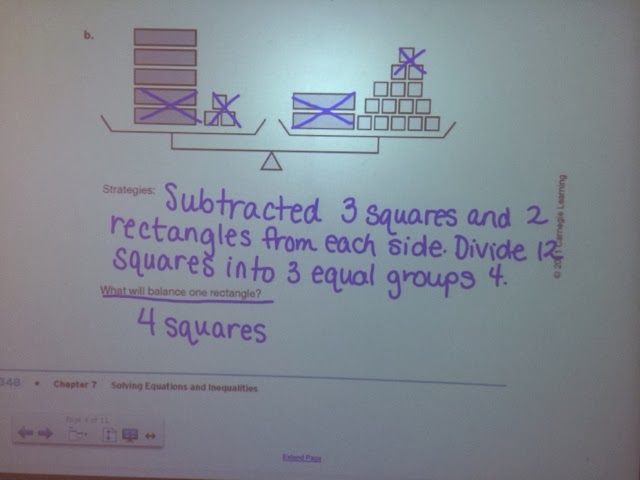
Day 1 Lesson was "Picture Algebra"


Day 2 Lesson was "Solving Equations"


On Friday my students had a MATHia Day where they spend the 60 min class working on the computer.  I gave the students this entrance slip as a warm-up.


While they were working on the computer I sat and graded the slips and started forming small groups for lessons on two-step equations.  I also have a class everyday day called Core Plus (different students on A/B days) which I use for intervention when students need it.   Core Plus meets right before lunch so I had my students from afternoon classes complete the slip.  I then started pulling small groups that day.  It's so helpful when I can get a jump on things during Core Plus because then those afternoon students can be more independent during class or MATHia and I can focus my efforts on the students who need help, but are not in my Core Plus.

Monday was another MATHia day and after the warm-up and a 5 minute mini-lesson modeling a MATHia problem I began pulling small groups.  I have a table in the back (or front depending on how you look at it) of the room where I can pull small groups of students. I pulled groups of 2-5 depending on what students needed help with.  I really need one more chair because I only have 5 chairs total and I use one of them.  I do have stool that kids love to sit on so that can be pulled over if a group is bigger than 4.


I started with students who showed the most mastery, but just needed little reminders on properly setting up equations and showing work.

I feel sometimes my time gets monopolized by the same handful of students who need more intervention time and I knew that the mini-lessons for the students who already show more mastery would go quickly so I started with them first.

I loved the conversations I had with the groups that were focusing on the higher level problems of having to first distribute and then solve the equation when there were variables on both sides.  We hadn't really done a problem like that yet and several students figured it out.

I was busy right up until the bell rang in every class.  I loved doing the small group lessons because once again I am getting a very good feel for where each individual student is at with their two-step equation solving.  I made some notes on students' slips when a few times I felt a student still needed more practice to become more fluent in their equation solving.


It was really easy to look at the students' slips and group them into small groups just by visually seeing their mistakes.  I would call the groups to the front table and each student had a dry erase board, marker, and erasing cloth.  Students had the option to work on their entrance slip or the dry erase board and they overwhelmingly chose to work on the dry erase board.

As a group was working each student would hold up their board as they completed a problem.  I could quickly scan the board and point out any errors or let them know it was perfect and they could move on the next problem.  Once a was satisfied (and they agreed) they were understanding the equation solving they went back to and worked on the computer.

Sunday, April 14, 2013

Slicing Three-Dimensional Figures- CC 7.G.3

CCSS 7.G.3 Describe the two-dimensional figures that result from slicing three-dimensional figures, as in plane section of right rectangular prisms and right rectangular pyramids.

I was really pleased with how the Carnegie Curriculum addressed this standard in the collaborative classroom text.  They devoted three lessons  to this standard:  slicing through a cube, slicing through right rectangular prisms, slicing through right rectangular pyramids.  My accelerated students really enjoyed these lessons and did a fabulous job working in their collaborative groups.

The lessons involved students making 3-d figures out of clay (although I used play doh).  Play doh worked very well and was easy to clean up and keep track of (each group got a different color play doh so there was no confusion).  I used the itty bitty containers that people give out for TOT sometimes.  This worked perfectly.  Each group had a container of play doh, a plastic knife, and dental floss.  Most groups preferred to use the plastic knife for slicing, but I did have a couple groups use the dental floss.  Students had to take turns shaping and slicing the figures.

This hand on lesson is something any teacher could easily put together.  I think it is helpful for students to see what those cross-sections look like because it can be difficult for students to sketch them.

My youngest son was not happy to see this play doh heading to school with me

Everything fit in a gallon ziplock
 Day 1 I forgot my camera so I have no photos.  Boo!  But really you can get the idea from the photos I took Days 2 and 3.  The students really enjoyed this hands on lesson and no matter how old they are, they still love play doh!
Slicing Day 2

More slicing Day 2

More slicing Day 2
 I only took one took two photos of them working the third day because I was so busy going around to each group and checking their answers with them.  Nice pyramid don't you think?
Day 3
Each lesson had a graphic organizer at the end where students had to cut out and match up the name of the cross-sectional shape with the appropriate diagram and verbal description of the way the figure was sliced.  I only took a photo of the graphic organizer the last day.  This one was done fairly neatly.  I tell you some of them lose those cutting skills they work so hard to develop in the primary grades by the time they hit 7th grade.  :)
Day 3 Graphic Organizer
I will admit that last year when I saw CCSS 7.G.3 I was kind of dreading it and thought it would be a pain and mess.  I am happy to say that the lessons were well developed and a perfect lead in to the lessons on surface area and volume (CCSS7.G.6)

Saturday, February 9, 2013

Curriculum Planning

With our new math implementation we are fortunate enough to have some full planning days to put together our Carnegie units.  The planning days definitely help and are greatly appreciated, but we still spend hours upon hours putting everything together on top of what we are able to accomplish in an eight hour planning day and during our PLC meetings.

This coming Monday is a planning day where another 7th grade math teacher (who is absolutely awesome getting all our assessments and assignments together) will out as much as we can for our next five chapters (we need to get through two chapters for sure).  Our math interventionist will be working with us in the afternoon so I am excited to have her on board to help us create some interventions in advance, rather than after the fact, like we tend to do.

We are lucky that we have Carnegie Learning a common core aligned math curriculum so we definitely have an overabundance of resources available.  As I am sure many of you will agree, teachers rarely are able to use the assignments and assessments as they are, that text companies provide.  This creates a lot of extra planning time to put everything together the way it works best for our students.  Again, I am quite lucky in that my colleague Bill, does almost all of that.  Our biggest task, is pulling together the best of what Carnegie has offered us for teaching the CCSS to our 7th graders.

I thought I would share with you the items that I list on our Google Doc as we do our Module Unit Planning so we can keep track of what everyone is responsible for and by what date they need to have it completed (well in a perfect world anyway).


Module Unit Planning:  A Module consists of two to three chapters

  • Chapter Quiz Review/AK (Answer Key)
  • Chapter Quiz/AK
  • Chapter Quiz Retake/AK
  • Chapter Quiz Correctives (students complete after the quiz)/AK
  • Module Test Review/AK (This covers 2-3 Chapters)
  • Module Test/AK
  • Module Test Retake/AK
  • Module Test Correctives (students complete after the test)/AK
  • Assignments/AK
  • Mathia Pacing/Assessment Guide
  • Mathia Small Group Lesson
  • Mathia Notes/Study Guides
  • Warm-Ups/AK
  • Exit Slips/AK
  • Mini Lessons/Small Group Instruction from exit slip information
  • Learning Goals/Assessment Correlation
  • Cross-Referencing Assessment Questions to Lessons
  • Lesson Plans
  • Lessons on SMARTboard software
  • Answers Keys to project on SMARTBoard
  • Word Wall Vocabulary 
  • Math Focus Wall Posters
  • Foldables/Notesheets
  • Anchor Charts
  • Core Plus Activities
  • Learning Stations Activities
  • Tech Enrichment/Learning Support

Its easy to see why unit planning feels overwhelming when there are so many different items that need to be either created completely by a teacher or modified.  That does not even include having to work through the lessons ourselves and do all the problems.  That also takes quite a bit of time and we do not even spend any of our planning time doing that.  We all do that on our own time.

We also have two components to our curriculum: collaborative classrooms lessons out of the text and Mathia personalized learning software.  We are definitely focusing much more on planning for the collaborative classroom this first year.  

The items highlighted in green are the things we have been doing and planning all year.  Those are the things we always try to accomplish on our planning days.  The items listed in pink are things that we have done at least a few times throughout the year, but need to be more consistent with them.  The other 7th grade math teachers have their own versions of word walls and math focus walls so those two items I really put on the list to remind myself to keep up with planning them in advance.

I have found a few foldables online that I have used with my students and shared with my colleagues.  I would really like to increase my use of foldables and start using anchor charts in my classroom.  I know my students would benefit greatly from both.  I just always seem to run out of time to do this justice as I would like.

We have a 45 min class every other day called Core Plus and this quarter I have Enrichment on A Days and Intervention on B Days.  I would like to be more purposeful in creating lessons to use on my Intervention day so there will perhaps be less need for retakes, a girl can dream, right?!  I also would like to create some fun and engaging learning stations to use on both my CP Enrichment and Intervention days.  I have some great resources for that.  I just need to find the time to put the stations together.

I have a laptop cart always available to me because the students work on Mathia software 1-2 days a week (as well as during CP or Homebase at the end of the day).  I would like to start using the technology more on my non Mathia days.  Maybe doing some exit slips on a Google Form or trying out Socrative.  Please share your favorite ideas of how you would use laptops in your classroom, if you have unlimited access.  I would love to try some engaging technology because right not they really just do Mathia.

One thing that I feel is a non-negotiable going forward is using exit slips (or whatever formative assessment preferred) to get instant feedback on students that can be used for targeted small group remediation or instruction.  I did that last week and considered it a huge success.  I just have to make the time to create the exit slips and mini-lessons that go with them.

How do you go about planning your math units?  Isn't it crazy how much more is involved these days than just opening up the book and teaching a lesson and then giving homework and a quiz or test?  Next year our district is going to Standards Based Grading so that will again really change the way we do things.  I tend to think it will end up being easier in the long run as we focus more on Power Standards.  I feel right now we are trying to assess nearly everything we teach and it becomes overwhelming for both us and the students.  I would love to hear any ideas or suggestions you have for anything relating to unit planning (how you are able to do it all), luckily I am on a team so we are able to split up the work.


Sunday, August 19, 2012

Goals for 2012-2013


I really need to stop this late night blogging pattern of the past couple nights.  The past two days have been jam packed with school related projects, back to school outlet mall shopping, fall baseball games, and a wonderful dinner with my parents.  Tomorrow I am heading into school to spend the day working on my classroom, as my boys are with my parents.  I am hoping to finish up my Math Focus Wall I have been busy working on and get some other things set up in my room.

This coming year is going to be a wild and crazy ride for me with implementing a new curriculum, Carnegie Learning, and a new personalized learning delivery model.  Can you say overwhelming and beyond exciting and innovative?  I am so energized for this coming school year, but will feel better once I feel I have a handle on how this will all work.

This year my classroom goals will really be driven by the initiatives that my district has chosen to undertake, including Personalized Learning Model with Carnegie Learning Curriculum, Standards Based Grading District Committee and Lesson Study Facilitation.

Stop:

  • Spending so many late evenings at school.  Last year I felt that I was NEVER home to help my two younger sons with their homework  due to all the after school meetings I had and trying to keep up with everything in my classroom.   I really need to change this year.  My goal is to pick one night a week to stay late at school, two max.  I need to make sure I remember that my own kids need to come first and they need guidance on their own homework.  Trying to keep working mommy guilt at bay as many of you know all too well.
  • Wasting time an energy on things I cannot control.  I must repeat the Serenity Prayer to myself on a daily basis and really remember why it is I chose to be a teacher.  I also need to keep in mind that everything I do needs to be for and about my students.
  • Spending time on things that do not directly impact my goal achievement.  It is so easy to get sidetracked on the day to day classroom minutiae and lose sight of what is really important.

Continue:

  • Co-teaching.  Last year the sped teacher and I really became more effective working together after taking a co-teaching class together, but due to my having a student teacher 4th quarter things we weren't really co-teaching at the end of the year.  I am really excited because we will be co-teaching both afternoon math classes this year.  Looking forward to taking our co-teaching to the next level!
  • Using learning stations for review and differentiation in the classroom.  Also using them more in my Core Plus class.
  • Working with my 7th grade math team during PLC time to implement our new program to fidelity and working together on compacting and assessment.

Start:

  • Researching and figuring out the best way to do conferencing with my students.  This will be an integral part of our personalized learning model.
  • Consistently doing some form of daily review with my students.  I started off strong with warm-ups last year, but then kind of fizzled out at the end of the year.
  • Really focusing on some of the things I learned during my Guided Math Book Study this summer.  I am really excited about my Math Focus Wall and really making my classroom a numeracy rich environment for my students this year.
  • Implementing Carnegie with fidelity and really focusing on the Common Core and Standards for Mathematical Practice.  I am so lucky to have a great curriculum to help me implement common core the way it is meant to be.


Friday, April 6, 2012

Carnegie Learning Math

If you are a regular follower of mine you know that I have spent this past school year helping to lead our k-12 math curriculum review as part of my middle school math liaison responsibilities.  I am happy to let you all know that a few weeks ago we finally chose our new math curriculum for grades 6-8.

We chose Carnegie Learning.   After MANY meetings we agreed 6-8 to adopt Carnegie for next school year.  They are fully Common Core aligned and the whole program is built around the Standards for Mathematical Practices.  What a blessing to find such a perfect math program to fit our needs!  Another very exciting development was that the high school ended up choosing Carnegie too.  They will be phasing the program in because I think Carnegie is still developing their higher level HS courses.

The 6-8 program has a 2011 copyright so this school year is the first year it was available commercially.  I do not know of any districts in WI that are currently using it at the middle school level.  If any of you readers know of ANYONE using this middle school curriculum, I would love for you to share contact info.  
All the teacher books are soft-cover and three hole punched.
We are trying to pilot some of the materials for the remainder of this school year with our students, just to start wrapping our brains around how it works.  There is an online component, in addition to consumable student textbooks.  I love that the texts are consumable so we are not stuck with a text for 6 yrs.  They have the ability to update and change things on a yearly basis.

I am still very unclear how this personalized learning approach will play out in our classrooms.  In 7th grade we are starting the year in our separate three math classrooms, but by semester we plan on teaching as a large group (although there is no space for 90 kids to be in a room together).  It's a very exciting time to be a math teacher and I think that in the end we are starting something that will really be transformational math education.  

There will lots of inservicing and other training for us as we move into uncharted territory.  Our director of instruction and our principal are both huge supporters of what we are attempting to do.  I will be doing lot of work this summer to prepare myself for all the changes next year.  I am just so pleased to have what I feel is a great curriculum to support this major shift in delivery model.  Again if any of you have any connections or experience with Carnegie I would love to hear from you!  I plan on perusing these over Spring Break.

All the preview materials we were sent.  The student text comes in two volumes.