Showing posts with label Binders. Show all posts

Monday, November 26, 2012

#Made4Math A few random things

This will be a quick post to share a few things I made today.  I realized that I have had a to do list of things I have been wanting to make on the computer since school started.  As is always the case, once school starts the things I want to do/make get replaced by the day to day minutiae of keeping a classroom running:  the planning, teaching, grading, reteaching, retaking, lather, rinse, repeat.


Seating charts/class lists binder

Vocabulary for word wall and CCSS posters

Math Focus Wall Labels


I finally was able to print out some new labels for my math focus wall.  I will be posting photos of the new and improved focus wall soon.  I have changed up what it looks like from what I had at the beginning of the year as I have seen what works and what could be improved.

After school I finished up my CC standards posters for The Number System domain (we are currently working on).  I also finished writing up the vocabulary words and will laminate them and the posters tomorrow.


Tuesday, March 20, 2012

Ratio and Proportional Reasoning

I cannot believe how hard it is to keep up with blogging.  We have been in a curriculum review process this school year and it has made my school life busier than I could have ever imagined.  The good news is that we are meeting today to choose a curriculum and then we can finally move forward in the planning phase.

About a month ago I was home for a day with a sick boy.  I ended up spending the day doing laundry and working on planning some activities on Ratio and Proportional Reasoning aligned to the common core.
Great resource book!
I have been reading the book Ratios, Proportions, & Proportional Reasoning Grades 6-8 for a few weeks in order to better understand the depth of what is expected with the new CCSS in math.  I have also been spending time going through the Progressions for the CCSS in math, draft for 6-7 Ratios and Proportional Relationships. I have found this document to be a wealth of information for this particular CC Domain.

My binder for Ratios and Proportional Reasoning
You can check out my previous post on Learning Stations for Ratios and Proportional Reasoning.  I highly recommend the book featured in that post for some great CC aligned learning station activities.  For those of you who follow me on Pinterest I think I will be adding a board on Ratio and Proportional Reasoning so I can pin specific activities for this CC domain.  In this previous post I shared a Ratio and Proportional Reasoning Foldabe I did with students.

Sunday, October 16, 2011

Organization-Papers

Hi teacher friends!  I know it seems I have disappeared off the face of the Earth (or at least the blogosphere), but I am alive and well and busier than ever.  With all the committee work I am doing at my middle school and as part of the district K-12 math review, and my leadership role as middle school math liaison, to put it mildly I am SWAMPED!

I am having a wonderful school year and have really great students, but homework completion and organization is more of a challenge for this class than in past years.  My new AP is awesome and everyone really seems to like him.  I have two new teachers on my team this year so it has really changed the dynamic of my teaching team, mostly for the positive.  There are some issues that need to be resolved, but enough about that.

I received an email the other day from a first year ESL teacher in NYC.  She is feeling overwhelmed and  asked for suggestions to help get organized.  I responded to her with some tips for keeping papers and paperwork organized.

I will be sharing some of those tips in this and future blog posts.  Hope you find this helpful.

Today I will be sharing how I organize the handouts that I give to students.  In my case this would include: note sheets, labsheets, practice worksheets, and any other handouts that students use in class.  Each Module (which is another word for chapter) of our math text is divided into sections, and each sections is divided into two or three explorations.  I color code all handouts by section with the following colors:  section one is yellow, two is green, three is blue, four is pink, five is goldenrod (only a couple modules have more than four sections), and six is purple.

I use my paper sorter to organize the papers I will be handing out to students.  This year, due to how busy I am, I have had a really hard getting all my copies made as far in advance as I am used to.  You get the idea though, from the photo of how I organize the papers.  The second last column on the right is holding manipulative packets for learning stations (the white papers).  I use the last column to organize random papers that I use regularly (or my students do), there is a section for plain white copy paper, looseleaf, and scrap paper (all for student use).  I also have have some fun bright colors for special copies I make.  We do all of our own copying and that is why you see the paper reams in the bottom row.  All the copies I had out to students that go in their binders are copied on special three-hole punched paper.  Any copies that do not go in their binders are copied on regular colored paper.  The kids love getting the prepunched colored paper because it helps to keep their math binders nice and organized.  Visually they can easily find a paper by looking in the correct section of their binder.

My vertical file cabinets hold my paper sorters for copies of student handouts
Now the question of what to do with any extra paper copies is an important one.  You don't want piles of random papers cluttering up your desk and within a couple of days your desk can suddenly look like a recycling basket, instead of a desk.  The method that I use is to have a file folder for each section of that module.  Any extra copies get grouped together and then separated with a colored piece of paper.
These file folders hold extra copies of student handouts after we are done with them
Another great thing about this method is that I keep the folders from year to year, if something gets changed the next year I will just transfer the old out of date papers to my scrap paper file.  Don't you just love it when a student comes and asks for a week's worth of homework because they are going on vacation?  This happens frequently in my district.  What I do in this case is pull out my lesson plan book from the previous year, got to my extra copies files and pull out any needed papers.  I always emphasize to students that we may do something different than what I give them, but usually it ends up being pretty close to what we do.  No last minute running around making extra copies for that students.
Each module is divided by section

How often do students lose copies of something, or maybe they do something wrong on their paper and prefer to start over with a clean copy?  This happens to me and it is so nice to just go to the file and grab what whatever copy the student needs.  Do you ever have a colleague looking for an extra copy of something?  Again just grab it from the appropriate file.  My students marvel at how organized I am when I can always find any copy they need at a moment's notice.  The whole color coding method is what makes this so quick.  If they need a worksheet from Module 1, Section three I immediately know I am looking for a blue sheet.

If I find random copies of sheets I can always tell by color what section they belong to (as can students). This is a KEY factor in our organization.  We do computer grading on PowerSchool and I even put the color of worksheets in the comments section.  That way if a student is missing Wksht 1-72 and it says (yellow) in the comments, they know that they are looking for a sheet from the section of yellow papers in his/her binder.  Then they don't come to me, asking what color it was (as they can see on PowerSchool).

These are papers for sections 1-3.  

Sections 4-5 papers as well as manipulative packets for learning stations

Keeping paperwork organized is one of the biggest challenges teaching middle school.  I teach four different math classes, as well as Core Plus so I shuffle a ridiculous amount of papers.  We try to go paperless whenever possible, but students need labsheets, note sheets, and some worksheets.  It is very important to keep those papers organized for yourself, as well, as to be a good role model for your students.  It's hard to expect students to be organized if you your own paperwork and desk are in constant disarray.

Friday, July 22, 2011

Organization of my Teacher Binders

I have been using binders to organized my teaching materials since back in the early '90s.  I was a pioneer back in the day when everyone else was using file folders to store things.  I am VERY picky about the copies I give out to students.  It drives me crazy when I see a poorly copied or crooked paper being passed out by a teacher.  I also prefer to have things typed out rather than handwritten (this is for passed out copies).  It just seems more polished and professional to me.

Organization is definitely a strength of mine when it comes to managing my classroom and teaching my students.  I use binders for all my math units (which are called modules in our series).  I have also fine tuned this organization for the students I teach when it comes to their math materials.  I require every student to bring in either a 1/2" or 1" three ring binder.  I am really a stickler on students needing to have a binder and keep a supply of extra ones so if a student needs one they get one within the first week of school.

The textbook series we currently use in our district for grades 6-8 is MathThematics by Mc Dougal Littell.  I teach 7th grade so we use Book 2.  Our text has a 2002 copyright and this book has a newer updated version.  Our district is under a K-12 Math review for the 2011-2012 school year and we will be choosing a new curriculum to implement for the 2012-2013 school year (as far as I know).  This is a standards based series with a spiral curriculum.  Various math strands are present in each module and the "theme" of the module is what ties it together.  Some themes work great, and some not so much.

I organize all my teaching materials into special Lifetime Binders.  Now these are not so easy to find anymore and they are pricey, but I have had these binders for years and never had any trouble with them.  The company that made them when I purchased them was bought out and now they are called Keba binders (or that is the manufacturer).  I did not pay $25 plus $7 shipping and handling.  I got a great deal on a set of them and payed maybe $15 a piece including shipping.  It was several years ago.  I think that over time they are proving to be a wise investment.  We have a running joke on my 7th grade math team about my "Lifetime Binders" and I told one of the other teachers that when I die I will leave him my Lifetime Binders in my will.  :)  You don't need these fancy binders, but I tell you I think they are worth every penny I spent on them.  I definitely need the 2 1/4" size to fit all materials from a module in them.

Part of my organization is that I color code all papers by section.  I either have copy masters on white paper for running student copies, or if it is an answer key I will write on one of the colored student copies.  This makes it very easy to organize extra copies and teaching resources as we go along in a unit.  This school year was super busy for me with some new initiatives we had and I just did not have the time to put things back in the binder like I could/should have.  The color coding system made it super easy for me to get everything together after the fact and get my binders back together in working order.

I use the same color system with my students and all copies they receive are three-hole punched other than assessments that never go in the binder.  The students love this system and it helps to keep them organized.  I can elaborate on the student binder in another post if anyone is interested.

Module 1 Binder (the cover sheet is on the inside that is why it looks blurry).

You can sort of see the color system.  

Cover sheet and Section Tabs.

Section Tabs up close.

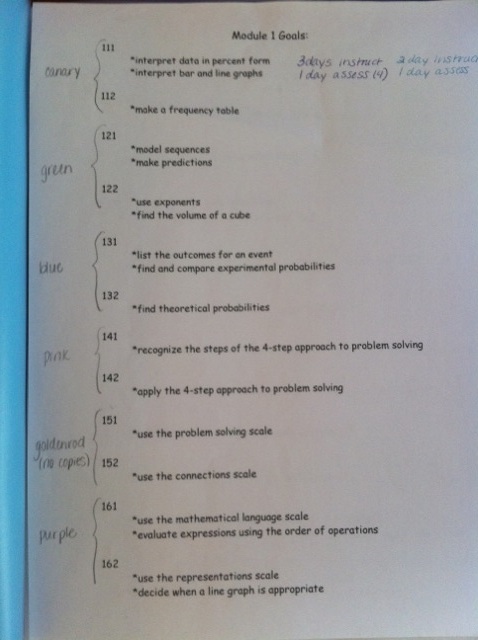
This has all the learning targets for the module.  You can see what color each section is.  When I first started color coding a few years ago I had to write down what color each section was, but now I keep it consistent for every module so I always no what section we are on by the color of the paper.
A couple other things I need to mention is that I use the extra wide tabs because everything that goes in the binder is put in a sheet protector.  My master copies are never three-hole punched, just the copies I make for the students.

I do have a SMARTBoard now so more of my files are digital and will be as we adopt a new curriculum.  I keep all my hard copies in the binder so if I have a sub that person has copies of what they need including the answer keys of everything.

Hopefully this post makes sense and is helpful.  Please let me know if you have any questions.  I would be happy to do a follow up post to explain things in more detail.  My binders definitely keep my materials organized and at my fingertips.  Extra student copies do not go in the binder, they go in color coded file folders (I warned you about my organization), with copies separated by section.