Saturday, July 20, 2013

Minds on Math Book Study-Chapter 7 "Minilessons"


Minds on Mathematics Book Study

If this is your first time joining our book study please click on the button above and it will link to all previous posts.  Feel free to go back and add a link to any previous chapters.  You can link up your post on Chapter 7 at the bottom of this post.  Please visit the other bloggers who have linked up below and leave them comments.  Lots of great ideas are being posted on other blogs!


This chapter did an excellent job of explaining the purpose of the minilesson portion of workshop and then also giving some great ideas of types of minilessons to do with your students.  I love the idea that your focus can vary from day to day when doing your minilesson.  The author gave some great examples of how to incorporate thinking strategies and the mathematical practice standards during this time.

I think that due to the fact that the minilesson is supposed to take ten minutes or less, it's really important to plan carefully what you want to accomplish during that time.  This is a shift from demonstrating procedures and showing students how to solve problems, to having them think like a mathematician as the teacher models reasoning processes and thinking.  We are using the minilesson to launch independent problem solving as students move into work time.

It's important for teachers to debrief with students at the end of the minilesson to help them take ownership of the problem solving process.  This is also a great time to implement some type of formative assessment to check for student understanding.  This formative assessment can help you decide if there are students that will need additional support to get started during work time.  That way you won't have students doing nothing during work time because they still aren't ready to complete the task independently.


Friday, July 19, 2013

Math Workshop Grades 4-8 Twitter Chat


Minds on Mathematics Book Study

I would like to schedule a twitter chat for our book study Minds on Mathematics  Using Workshop to Develop Deep Understanding in Grades 4-8.  If you are visiting for the first time you can click the button above to see all previous posts about our book study.  

Several people have expressed interest in doing a chat because it would be an easier way for everyone to connect and share ideas about the book.  Please continue to link up your blog posts for every chapter so they are there as a resource for anyone wanting to know more about the book.

Just leave a comment below on what days/times work best for you to chat on twitter or if you prefer you can leave me a comment on twitter @luvbcd  Remember that you do not have to be in the book study to participate in the twitter chat.  It would just help your understanding of the discussion, but everyone should feel free to join in.  We'd love to hear from anyone who has already done a workshop model in the math classroom.

We'll try and schedule a chat this coming week and see how things go.  Thanks for all that are participating.  Leave a comment with your preference for chat time/day.

*UPDATE*  Twitter chat for Minds on Math Book Study will be Tues. July 30 7-8PM CST 8-9PM EST.  Please join the chat by following #momathchat


Tuesday, July 16, 2013

Minds on Math Book Study-Chapter 6 "Opening"


Minds on Mathematics Book Study

If this is your first time joining our book study please click on the button above and it will link to all previous posts.  Feel free to go back and add a link to any previous chapters.  You can link up your post on Chapter 6 at the bottom of this post.  Please visit the other bloggers who have linked up below and leave them comments.  Lots of great ideas are being posted on other blogs!


I enjoyed Chapter 6 on the Opening.  I have always had a routine of students completing a warm-up while I circulate around the room stamping homework.  I know many times the warm-up might get cut out because of time or what we were doing that day.  I really need to make sure the opening is really setting the stage for what we are doing in class that day.  There are so many possibilities of what can be done those first five minutes.  The most important thing is that we want to get students engaged in and thinking about math.

I loved the table on page 95 where the author gave examples of how you can use the seven thinking strategies when working on a problem or when discussing a concept.  I really need to start implementing these thinking strategies as I continue to put greater emphasis on the Standards for Mathematical Practice in my classroom discussions (and workshop opening).

I think this chapter seems so obvious and common sense about the importance of the opening, but it's so easy for a busy teach to gloss over or skip this part completely.  We really have to establish this integral part of the workshop routine in our classrooms on a daily basis.  By carefully planning out those first few minutes of class we are sending a message to students about what we value, expect, and hope.

Thanks for joining in everyone!

Sunday, July 14, 2013

Minds on Math Book Study-Chapter 5 "Discourse"


Minds on Mathematics Book Study

If this is your first time joining our book study please click on the button above and it will link to all previous posts.  Feel free to go back and add a link to any previous chapters.  You can link up your post on Chapter 5 at the bottom of this post.  Please visit the other bloggers who have linked up below and leave them comments.  Lots of great ideas are being posted on other blogs!


This chapter was filled with lots of great examples of how to promote effective discourse in your mathematics classroom.  It is so important to model for our students what we expect them to be doing during discussions.  One of my favorite sections in this chapters was on creating an atmosphere of respect for thinking.  I loved the example where the little girl said, "I disagree with myself".  We need to create a classroom culture where students take risks to share their ideas knowing that others might disagree or ask for clarification.  By inviting peer comments and questions students begin critiquing each others' work and thinking.

We need to be careful as teachers that we don't shut down the opportunity for great discourse by jumping in with an affirming comment, causing the students to stop sharing.  I know I have a habit of doing this and really need to work on keeping the discussion going by doing things like promoting questioning, inviting comparison, checking for agreement, and encouraging divergent thinking.  I like the idea of having sentence stems for students for students to explain their thinking of to respond to the ideas of others.

Taking time to uncover errors is another thing I really need to spend more time focusing on.  Students come to us with many mathematical misconceptions, some of which they hold on to very tightly.  It is worth our time and effort to analyze these errors which will lead to a deeper understanding of the concept.

Moving forward I see many strategies I will employ this year as I transition to math workshop.  I felt my students had very rich discourse this past year, but see so many areas where I can take them to the next level which will promote a much deeper understanding of the math they are learning.

Thanks everyone for joining our discussion on Chapter 5!

Tuesday, July 9, 2013

Minds on Math Book Study-Chapter 4 "Community"


Minds on Mathematics Book Study

If this is your first time joining our book study please click on the button above and it will link to all previous posts.  Feel free to go back and add a link to any previous chapters.  You can link up your post on Chapter 4 at the bottom of this post.  Please visit the other bloggers who have linked up below and leave them comments.  Lots of great ideas are being posted on other blogs!
I really enjoyed this chapter.  There were so many ideas that I really connected with.  I love the idea and completely agree that a learning community to be authentic is a culture you create in your classroom not a structure.  If we want students to behave like mathematicians then we need to establish a classroom culture where we treat them as such.  This was my big ah hah in this chapter.

This chapter has really given me a lot to think about as I plan to implement the workshop model in my classroom this fall.  I really agree with the author that you need to take some time the first few days of having students to create the culture of your classroom.  

My students worked in collaborative groups last year.  I was impressed with how well things went, but there is definitely lots of room for improvement.  One of the "yeah, buts" in this chapter was about about special needs students.  I saw some very impressive results in my special ed inclusion hours.  Students that would never raise their hands to answer questions would be able to discuss their answers as part of their small groups.  I really felt some students that I would normally never hear from if I taught to the large group, would give feedback in their small groups.  It was something to see.

I want to challenge you all to not underestimate what your students are capable of doing as far as collaboration goes.  I started out with my accelerated class because I knew they would do great and they did.  It took me a whole extra quarter before I finally jumped in with my regular classes (two of which are special ed inclusion hours).  I kept thinking it would not work in those other classes.  What I found was it worked great (maybe not as easily as with the accel, but great nonetheless).

This goes back to a previous chapter where Wendy Ward Hoffer spoke about all students being capable of brilliance.  We need to give them the tools to show us their brilliance and by building a strong sense of community in our classrooms we are doing just that.

Thanks for linking up everyone!  


Saturday, July 6, 2013

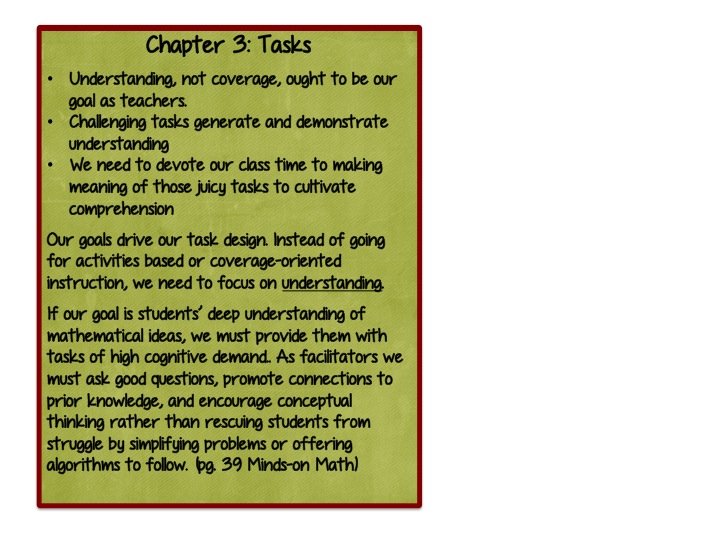
Minds on Math Workshop-Chapter 3 "Tasks"


Minds on Mathematics Book Study
If this is your first time joining our book study please click on the button above and it will link to all previous posts.  Feel free to go back and add a link to any previous chapters.  You can link up your post on chapter 3 at the bottom of this post.  Please visit the other bloggers who have linked up below and leave them comments.  Lots of great ideas are being posted!

One thing about this chapter that perplexed me was the opening story about 7th graders rolling two dice to get the product and see if they were odd or even.  I am wondering if that was a typo because it seems more like a 2nd or 3rd grade task.  Did anyone else find that example to be odd for a 7th grade classroom?

This chapter was interesting for me because I feel like we have a very rigorous curriculum with deep and challenging tasks.  I have seen personally that you really have to have multiple entry points when you have a class full of diverse students with different ability levels and background knowledge.  I found these tasks worked so well in my accelerated math class, but were much more of a challenge for students and myself in my regular math classes.  All students do need to have access to these rich tasks so it's a matter of figuring out how give students the tools to be able to understand these challenging tasks.  I am looking forward to future chapters that will address these issues of how to use modeling, classroom discourse, and reflection to help with scaffolding these types of problems.

For those of you that do not have a strong curriculum with challenging tasks there are so many free resources available to you online.  You can check out my CCSS Pinterest board for links to many free common core resources where you will find challenging tasks.

Tuesday, July 2, 2013

Minds on Math Workshop Chapter 2- "Tools"

Minds on Mathematics Book Study

If this is your first time joining our book study you can click here to see all previous posts related to the book study.   Please remember to put the book study button shown at the right into your post and link your blog post at the bottom of this post so that other people can visit your blog and see your thoughts. If you missed Chapter 1 please feel free to link up your post on that chapter at any time.  The link will remain open.

I did not post any discussion questions for this chapter so feel free to discuss whatever you found interesting from this chapter as well as any wonderings you have.

I am very familiar with the CC Standards for Mathematical Practice.  I do use them purposefully in my classroom and model and share with students when we are using a particular standard in an effort to familiarize them with the standards.  I love the idea of deliberately adding a process standard to my plans when looking at my content learning targets.  I think embedding these tools into my lesson planning will make a stronger and more meaningful connection.

The thinking strategies will help students to construct meaning as they work to read through tasks and solve problems in the mathematics classroom.

I look forward to reading all of your posts.  Thanks for linking up!